
PEMF Mats for Pain Relief 2026 The Best 3 Mats based on 56 PEMF for Pain Research Studies
After analyzing 56 PEMF for pain studies and comparing mats to that research 3 stand out with one being a clear winner.
#1 Overall Best for Pain Relief
Healthy Wave High Intensity
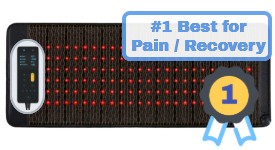
Best pain relief PEMF mat pick because of multi pain relief therapies and a more intense PEMF right in the window where pain relief studies cluster.
PEMF Flexibility Pick
Healthy Wave Multi-Wave Mat
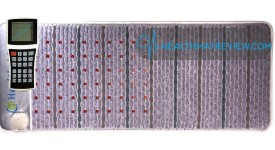
Maximum PEMF adjustability while including multi pain relief therapies, great for covering multiple scenarios, pain, recovery, sleep and more.
PEMF Only Pick
OMI PEMF Beyond Mat
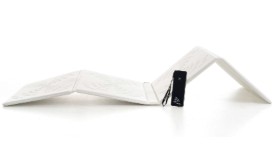
PEMF only choice, missing the multi pain relief therapies but including even more PEMF flexibility, 3 waveforms, 0-100% intensity adjustment and 99 frequencies.
Why these three mats for pain relief
PEMF Research Window
- Best cluster hit: Healthy Wave High-Intensity
- Most flexible 3-therapy option: Healthy Wave Multi-Wave
- PEMF-only adjustable option: OMI Beyond
Pain Relief Modalities
Deep electromagnetic field; the main research-based filter for this page.
Penetrating warmth that may help with muscle tension, stiffness, and circulation.
A separate light-based pathway tied to cellular energy, recovery, and inflammation research.
PEMF for pain – what the research shows
A summary of findings from my analysis of 56 pain-tagged studies in the PEMF for pain research database, including the frequency and intensity ranges where positive results cluster most.
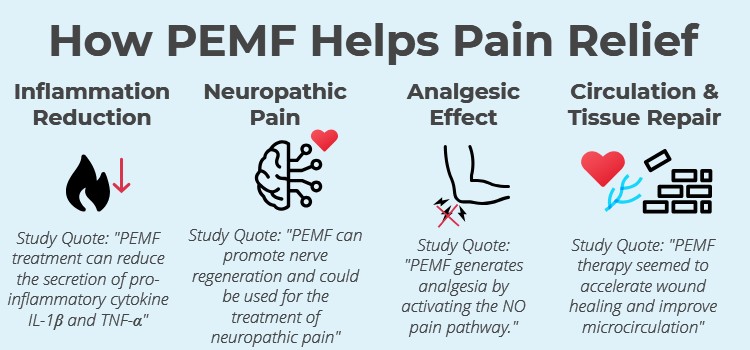
The 4 mechanisms by which PEMF may help reduce pain, based on findings from the research database.
Across the 56 studies, over 80% reported a positive outcome for pain.
PEMF isn’t a cure for any condition – none of the studies framed it that way but the signal across the literature is consistent enough to take seriously.
The research points to four mechanisms that may explain why:
Inflammation reduction
PEMF may modulate the inflammatory response, including reducing pro-inflammatory cytokines IL-1β and TNF-α at the cellular level.
Nerve regeneration
In neuropathic pain models, PEMF showed the ability to promote nerve regeneration, suggesting a potential role in managing neuropathic and radicular pain.
Analgesic effect
PEMF may generate analgesia (meaning numbing/pain reduction) via the nitric oxide (NO) pain pathway, providing a direct pain-blocking mechanism independent of inflammation.
Microcirculation and tissue repair
PEMF may accelerate wound healing and improve microcirculation, supporting tissue repair in both acute and chronic pain conditions.
Beyond the mechanisms, the analysis revealed which signal settings produced positive results most often.
The two charts below show results by frequency range and intensity range across all 56 studies.
This is the data behind the mat selection criteria above.
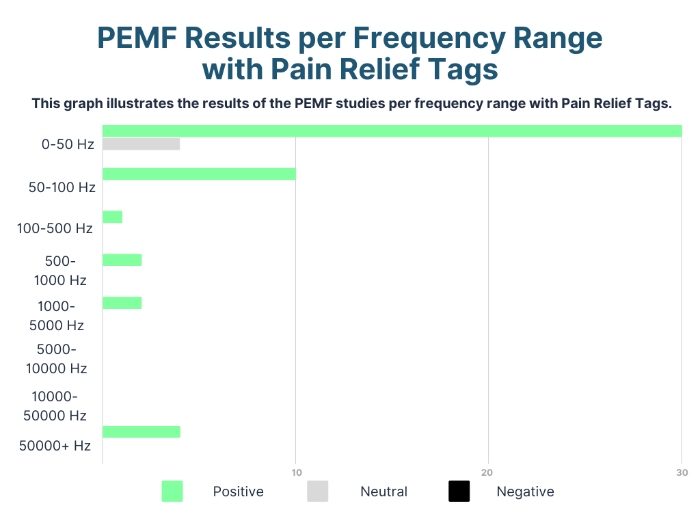
Results by frequency range. Positive outcomes cluster heavily under 30 Hz.
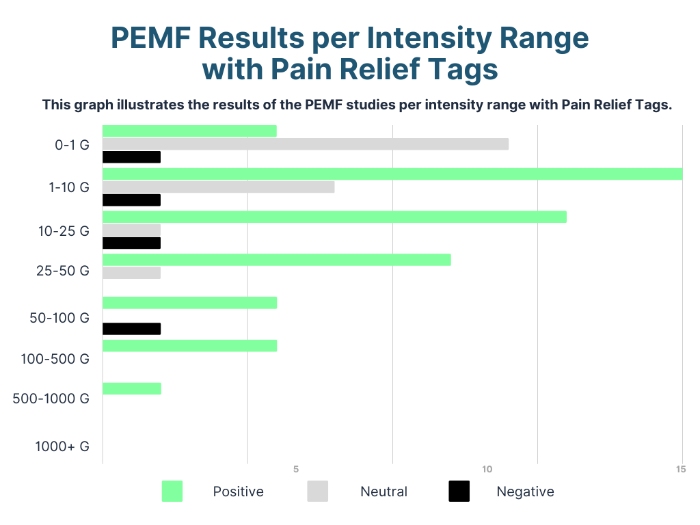
Results by intensity range. The 10 to 25 Gauss basket shows the strongest positive signal.
- ◎ Frequency under 30 Hz – positive results cluster here across the 56 studies, heaviest weighting under 20 Hz
- ◎ Intensity 10 to 25 Gauss – the range with the most consistent positive results, below 10 Gauss more neutral outcomes appear
No study directly compared settings head-to-head for pain, so these aren’t prescriptive targets – they’re the settings where the research has concentrated most.
This page is educational only and not medical advice. Always consult your doctor before starting or changing any therapy. See the full PEMF for pain analysis for the complete study breakdown including results by waveform and year.
PEMF Operating Chart of All 3 Mats Compared to Pain Research
Here's the visual look at how these 3 mats compare to the pain research cluster range; bearing in mind again that the research does show benefit for pain really across all intensities and frequencies, but this range had the most positive result studies.
You can see on the chart below the blue "research cluster" blocks, that's the 10-25 G and 0-30Hz range we saw on the charts further up the page composed of findings from the 56 PEMF for pain research studies.
I've then indicated the operating ranges of each of the 3 mats; you can see the Multi-wave and OMI both have a solid range because they have adjustable intensities as well as frequency, while the High intensity mat shows a shaded range but with arrows indicated the peak.
This is because the High intensity does not have adjustable intensity, but on average will output 7G across the mat with a 30G peak.
So this is really the reason the Healthy Wave High Intensity takes the first pick for pain relief, because it peaks at a higher intensity, right through the heavy cluster of research weighting positive results.
Note that the research cluster block looks narrower on the OMI chart, this is just because the frequency on the horizontal axis goes up to 99Hz, instead of 30Hz like for both of the Healthy Wave charts.
Each panel shows the mat's PEMF operating range against the pain research cluster zone (blue shading). The cluster marks the frequency and intensity range where positive pain outcomes are most concentrated across 56 studies.
- ✓ Healthy Wave High-Intensity - 0.25 to 30 Hz, 7 Gauss avg, 30+ Gauss peak, sits inside this window across all intensity settings. Higher average intensity makes this the strongest pain-focused pick of the three
- ✓ Healthy Wave Multi-Wave - 1 to 30 Hz, up to 5 Gauss peak, covers the frequency window with adjustable intensity
- ✓ OMI Beyond - 1 to 99 Hz, fully adjustable intensity 0 to 100% of 10 Gauss max, widest PEMF adjustability of the three
Why infrared and red light also matter for pain
I personally can't overstate the difference infrared heat made during my own back pain recovery, and both infrared and red light therapy have substantial research behind their potential role in pain relief.
Most PEMF mats are just that: PEMF only. The Healthy Wave High-Intensity and Multi-Wave both include far infrared and red light therapy alongside PEMF, which means they're addressing pain through multiple independent mechanisms at the same time.
Far infrared has a well-documented track record in back pain research. Unlike surface heat from a standard heating pad, far infrared penetrates deeper into tissue, reaching muscles, joints, and the areas where pain actually originates. Studies in low back pain populations have found meaningful reductions in pain scores and disability with regular infrared use, and the mechanism is straightforward: improved microcirculation, reduced muscle tension, and direct thermal analgesic effects.
I went through a severe L5-S1 disc protrusion a few years ago. The pain was constant regardless of position, and it lasted close to a year. My infrared mat became something I used every evening during that period, sometimes for an hour or two at a time.
It still surprises me now how much the infrared heat from my mat will help my back when I'm having a flare up of some kind. It made a huge difference during that debilitating period of my disc protrustion. It didn't fix the disc, but it gave me genuine relief consistently. Warm, penetrating heat has a quality that surface heating can't replicate. You feel it getting into the tissue in a way that a hot water bottle doesn't.
That experience is a big part of why I weight infrared so heavily when recommending a mat for pain specifically. The research says the same thing but I wouldn't need the research to try and convince you just based on my own experience. See the full infrared mat benefits page for the study references and more detail on the mechanisms.
Red light therapy (630 to 850 nm wavelengths) works through a different mechanism again. At the cellular level, red and near-infrared light stimulates mitochondrial activity and ATP production, which supports tissue repair and has shown anti-inflammatory effects in research. The evidence base is earlier-stage than the data on infrared heat, but there is enough real research there that it adds a third pain-relevant pathway to the mat.
The diagram below shows how deep each therapy actually penetrates from the mat surface. PEMF reaches bone and deep nerve tissue. Infrared reaches through to muscle. Red light works at the skin and cellular level. Each one is doing something different, which is why having all three working together is the best you can get in a PEMF mat for pain relief.
The Healthy Wave High-Intensity offers all three therapies simultaneously, with a higher intensity PEMF field to deliver stronger PEMF to a greater depth.
This is why the Healthy Wave High-Intensity is my #1 pick for pain relief specifically.
On PEMF signal alone, the High-Intensity and the OMI Beyond are both strong options. But the High-Intensity also delivers far infrared and red light therapy in the same session giving you 2 additional angles of treatment at once. For someone using a mat primarily for pain, the multi-combination is hard to argue against.
PEMF Mats for Pain Relief Comparison Table
Here's the detailed comparison on all aspects of these 3 PEMF mats including all the brand policies; return policies and warranties are something to consider at these price points..
Swipe ← / → to see all
Healthy Wave High Intensity PEMF Mat
Price Range
Pain Therapies

Product Options
Return Policy
Warranty
Editor's Take
My top pick for pain relief on this page. Operates in the range where PEMF pain studies cluster most heavily from 0.25 to 30 Hz, 7 Gauss average and 30+ Gauss peak, well inside the window where positive results are strongest. The infrared heat and red light add two additional independent pain mechanisms on top of the PEMF. As close to clinical-grade intensity as you'll find in a home mat. Comes with an amazing return policy too if you find it doesn't help you.
Pain Therapies
Product Options
Return Policy
Warranty
Editor's Take
Covers the PEMF pain research window with the most adjustable signal in a mat which also includes infrared and red light therapies, giving you the same three-therapy combination as the High-Intensity but at lower peak intensity. Warranty and return policy are top notch with the Multi-wave, same as the High-Intensity. If you want one mat that covers you for pain, sleep and recovery without limiting your PEMF signal and flexibility options in the future then this is the right choice for you.
Pain Therapies

Product Options
Return Policy
Warranty
Editor's Take
Strongest PEMF-only option for pain relief. Three waveforms, 99 frequency settings from 1 to 99 Hz, fully adjustable intensity up to 10 Gauss. Covers the pain research window and gives you more signal flexibility than any fixed-setting mat. Note that the PEMF isn't as strong as in the High-intensity, a real consideration if you're looking specifically for pain relief as is no infrared or red light therapies. Requires the OMI phone app to operate. For a buyer who specifically wants PEMF-only or already uses infrared separately, this is the pick.
PEMF Safety: What you should know
FDA Registration and Guidelines for Electro-magnetic Field Exposure are two things to consider when picking a PEMF mat, here we'll briefly review for these 3 mats but for more details see the PEMF Safety section on our Best PEMF mats page or our dedicated PEMF safety page for more information including my own adverse experience.
PEMF mats are generally safe to use with some individualized considerations, for example there are contraindications of use for certain people, while others may just respond differently to PEMF.
Responding differently I mean for example in my case I don't tend to like higher frequencies, you can read about that in my adverse experience with PEMF.
FDA Registration
There's just a couple things to understand on FDA registration.
A brand can be registered with the FDA, and it can or may have a FDA 510(K) form which is a review of their product to deem it safe for the public - this is different than "FDA approval" which is a more rigorous review typically only reserved for Class 3 high-risk devices like a pacemaker for example.
When a brand has been registered with the FDA, then their product may or may not require a 510(K) form, Healthy Wave and OMI are both registered with the FDA for their products.
For the 3 mats we're comparing here all of them are exempt from the FDA 510(K) form requirement and are deemed safe products for the public.
See more details on this including the registration numbers in the FDA registration of PEMF mats section of my main best PEMF mat comparison page.
Electro-magnetic Field Exposure Guidelines
We're all surrounded by electronics that emit electromagnetic fields (EMFs).
The ICNIRP, the International Commission on Non-Ionizing Radiation Protection, founded in 1992 exists to establish safe exposure limits for these fields.
PEMF falls into the "non-ionizing" category, meaning its frequencies are too low to heat body tissue or ionize cells.
The ICNIRP publishes charts showing safe intensity and frequency thresholds at two levels: the lower line is the general public limit (for continuous, long-term exposure by anyone), and the upper line is the occupational limit (for roughly 8 hours of daily exposure by workers).
The charts below plot each mat's operating range against these thresholds. Intensity is shown in Tesla on the vertical axis and frequency in Hz on the horizontal, I've added a Gauss conversion since that's the unit more commonly used in PEMF. The green line marks the general public limit; the red line marks the occupational limit.
A typical PEMF session is far shorter than the continuous-exposure timeframes these limits are based on, so even readings that approach the occupational line are unlikely to be a concern for normal use. The charts become most relevant if you use a mat for extended periods for example, sleeping on it overnight.
Healthy Wave High Intensity PRO PEMF Mat — Operating Range vs ICNIRP Magnetic Field Limits
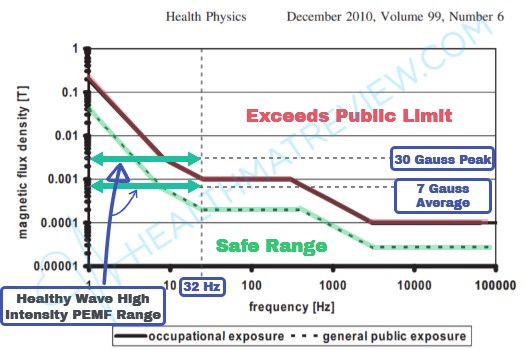
In this case you can see at max frequency the high intensity mat just begins to enter the beyond occupational exposure line - as I reviewed above occupational exposure is ~8hrs a day on a full time basis and a short PEMF session above is likely safe.
Takeaway: if I was using the Healthy Wave high intensity mat to get closer to clinical PEMF at home I would use it at a lower frequency setting if I was using it overnight or for long durations.
Healthy Wave Multi-Wave PEMF Mat — Operating Range vs ICNIRP Magnetic Field Limits
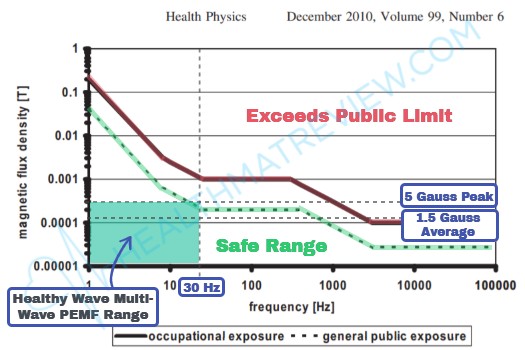
- Using Multi-Wave controller above (incl. 3 drop off rates & 2 waveforms);
- Classic controller also included, not shown on chart above (non-adjustable intensity, single waveform, 3.5 Gauss average, 15 Gauss peak, with 1 to 30 Hz frequency)
- Shows tested peak gauss and average - PEMF will have varying intensity depending on distance from PEMF coils (height above mat, horizontal distance from coil location; this is true of all PEMF mats)
One aspect I particularly like about the Multi-Wave (and the Healthy Wave PRO mats), that no matter what PEMF setting you select of the many options, it’s always operating within the safe range.
OMI Beyond PEMF Mat — Operating Range vs ICNIRP Magnetic Field Limits
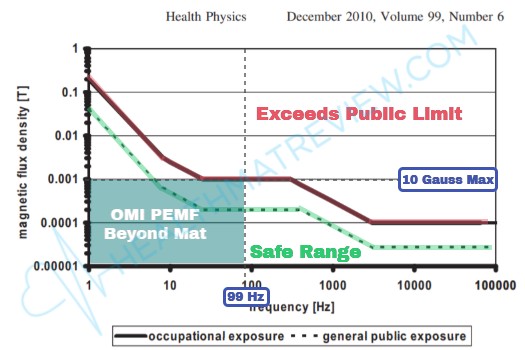
- OMI beyond PEMF mat also has 3 waveforms, sine, square and saw not depicted above
The OMI Beyond PEMF mat operates right within the occupational exposure lines on the chart above with amazing PEMF setting options 1 to 99 Hz and fully adjustable intensity (along with their multiple waveforms, and 100 preset programs) but for pain specifically I can't recommend it over the Healthy Wave mats because of their infrared heat and red light therapy as discussed further up on the page.
Some PEMF devices operate at extremely high intensity, typically these aren't PEMF mats and will have a large box controller with them.
Generally speaking those type of devices are seen more in clinicians offices and not for home use.
There's more than one school of thought on them, for our purposes comparing PEMF mats for pain I thought it relevant to show you the operating ranges of these mats relative to the ICNIRP exposure guidelines; to give a point of reference.
Regardless all of this just goes to show that there isn't any concern in using any of these 3 mats for regular home use.
I did write a page on whether high intensity PEMF is safe, and you can also see more details of this on the PEMF safety page which I've already linked to as well as on my main best PEMF mats page; feel free to leave questions in the comments at the bottom of this page also.
Return & Warranty Policy Details
Let's look at the policy details side by side, including all the details of each.
Important with any large purchase is the brand's policies.
Maybe more so when it comes to finding a PEMF mat for pain specifically because you really want to know whether or not this thing is going to help for YOUR case and not someone else's.
Not easy to do and it does become another reason that I emphasize Healthy Wave as my primary recommendation because with 3 months to initiate a return you have real time to put it to use and see if it helps you.
| Product | Return Policy | Warranty |
|---|---|---|
|
Healthy Wave High-Intensity PRO
$399 – $1,649 USD Shop High-Intensity Mat → |
90 days · 100% money back
|
Mat — 2.25 year full
|
|
Healthy Wave Multi-Wave
$995 – $2,495 USD Shop Multi-Wave Mat → |
90 days · 100% money back
|
Mat — 2.25 year full
|
|
OMI PEMF Beyond Mat
$990 – $1,990 USD Shop OMI Beyond Mat → |
30 days · 100% money back
|
Mat — 3 year full
|
What to look for in a PEMF mat for pain
- 1 Frequency range under 30 Hz. The pain research cluster sits here. A mat with only fixed high-frequency settings - or a single setting above 30 Hz - won't replicate the protocols where positive results are most concentrated. Look for adjustable settings covering at least 1 to 30 Hz.
- 2 Intensity reaching 10 Gauss or above at the surface. The 10 to 25 Gauss range is where the pain research has the strongest positive weighting. Mats that only reach 1 to 5 Gauss at the surface are working in a range where neutral outcomes are more common in the data..
- 3 Infrared if pain is the primary goal. Far infrared adds an independent pain mechanism - deep tissue heat, circulation improvement, muscle relaxation. If you're choosing between two otherwise similar mats and one includes infrared, that's a meaningful difference for pain specifically. Not all mats include it.
- 4 Return policy long enough to actually test it. Pain response takes time to assess. A 30-day window barely gives you a month of use. A 90-day return policy gives you enough time to run a real protocol and evaluate whether it's working. Healthy Wave offers 90 days; most competitors offer 30.
- 5 Controller warranty specifically. The PEMF controller is the component most likely to fail over time - it's complex electronics running constant on-off switching under load. A mat warranty doesn't help if the controller fails outside its coverage. Check both: mat warranty and controller warranty separately. Healthy Wave's 5-year controller warranty is the strongest in this category.
PEMF vs other pain relief options
PEMF vs TENS. TENS (transcutaneous electrical nerve stimulation) works by disrupting pain signals at the surface - it's effective for acute, on-demand pain relief and widely used in physiotherapy. PEMF operates differently; it works at a cellular level through electromagnetic fields, targeting inflammation, nerve function, and circulation rather than blocking pain signals directly. TENS tends to give faster on-session relief. PEMF's effects are more cumulative and may address underlying mechanisms rather than masking symptoms. They're not competing - some people use both.
PEMF vs heating pads. Standard heating pads work at the skin surface. They're good for comfort and surface muscle relaxation, but heat penetration is limited. Far infrared goes deeper - it's a different mechanism from surface heat and has clinical research behind it for back pain specifically. A PEMF mat with infrared is doing something a regular heating pad can't.
PEMF vs infrared-only mats. Infrared-only mats are legitimate pain relief tools and I'd recommend one over nothing. But PEMF adds inflammation modulation, nerve effects, and analgesic mechanisms that infrared doesn't cover. If you're choosing between an infrared-only mat and a PEMF mat with infrared at a similar price point, the PEMF mat covers more of the pain picture.
PEMF as an adjunct, not a replacement. None of the research frames PEMF as a standalone cure for any pain condition. The studies show it as a useful complement to other care - physiotherapy, prescribed movement, medical treatment. If you're managing chronic pain, it's worth integrating, not substituting. For my year or two of back pain it helped when I didn't want to take any more pain killers.
How to use a PEMF mat for pain
Session length and frequency. The randomized trials in the pain research database used a range of protocols. Back pain studies commonly used 12 sessions over 4 weeks (3 sessions per week), each lasting 20 to 30 minutes. Knee osteoarthritis trials ranged from 15-minute sessions up to extended daily use. Home mat manuals typically suggest daily use of 20 to 40 minutes. Consistency matters more than session length - short daily sessions are more useful than infrequent long ones.
Frequency and intensity settings. The research doesn't give a clear winning setting for pain. What it does show is that positive results cluster under 30 Hz and between 10 to 25 Gauss. Start in that range. If you have a mat with adjustable settings, begin at a lower intensity and work up gradually over the first few weeks. Some people are more sensitive to PEMF than others, and starting gentle is sensible regardless of your goal. Check out our PEMF frequency charts page for frequency guidance and a helpful frequency picker tool.
Positioning. Place the mat under or over the area of pain where possible. For back pain, lying directly on the mat is the standard approach. The electromagnetic field penetrates through the body, so you don't need skin contact - lying on a thin sheet or clothing is fine. For larger mats covering the full body, you get systemic exposure rather than targeted treatment, which has its own benefit.
Combining with infrared. If your mat includes infrared, running both simultaneously is the default approach. The heat from infrared takes 10 to 15 minutes to build, so allow the mat to warm before your session if you want the infrared benefit from the start.
Frequently Asked Questions
With the Healthy Wave mats which include both PEMF, infrared and red light therapy, a common question is do you have to always use the heat if you don't want to, or the red lights, the answer is you can use all of them separately and independently, or together. One at a time, two at a time, or all three at once, however you prefer.
Based on my analysis of 56 PEMF pain studies, the Healthy Wave High-Intensity is the top pick. Its PEMF signal (0.25-30 Hz, 7 Gauss average, 30+ Gauss peak) sits inside the frequency and intensity range where positive pain results cluster most heavily in the research. It also includes far infrared and red light therapy, which adds two independent pain mechanisms on top of the PEMF. If you specifically want PEMF only, the OMI Beyond is the strongest option for that.
No study has directly compared frequencies head-to-head for pain relief, so there's no single proven "best" frequency. What the research does show is that positive outcomes are most concentrated under 30 Hz. Most PEMF mats designed for home use operate in this range. See the full frequency analysis on the PEMF for pain research page.
Again, no head-to-head comparison exists. The pattern in the 56-study analysis shows the 10 to 25 Gauss range producing the strongest concentration of positive results. Studies using intensities below 10 Gauss showed more neutral outcomes on average. This is one reason why higher-intensity mats tend to be recommended for pain-focused use over lower-intensity options.
Most randomized trials in the pain research database measured outcomes over 4 to 8 weeks, with protocols typically running 3 sessions per week. Some studies reported improvements within 1 to 2 weeks; others measured results at the 4-week mark. Anecdotally, many people report noticing something within the first few sessions, though this varies considerably. Consistent use over weeks is what the research supports - not single-session results.
Several randomized controlled trials have specifically studied PEMF for non-specific low back pain. Results generally showed reductions in pain scores and improvements in mobility compared to control groups. In the studies reviewed, PEMF was used as an adjunct to conventional treatment, not a replacement. If you have chronic back pain, using a mat consistently alongside whatever other care you're receiving is the approach most consistent with how it's been studied. Always consult your doctor before starting any new therapy. In my own case of debilitating back pain I can't overstate how much of a difference the infrared heat of my Healthy Wave mat made for me on a daily basis.
Research on PEMF for neuropathic pain and radiculopathy (nerve root pain) shows positive results across several studies. Animal models and human trials both suggest PEMF may promote nerve regeneration and modulate neuropathic pain through inflammation and ion channel effects. It's not a standalone treatment for nerve damage, but the evidence for it as a conservative adjunct is meaningful. See the nerve pain section on the PEMF for pain research page for specific study references.
The research doesn't show PEMF causing harm at the settings used in home mats - the ICNIRP safety guidelines for electromagnetic field exposure are generally well-respected by the major manufacturers. That said, some people report feeling fatigued or experiencing temporary discomfort when starting at high intensity. Starting at lower settings and building up is sensible. For more on PEMF safety and ICNIRP guidelines, see the PEMF safety page. I myself found that I do not like PEMF frequencies of 30Hz or above.
They work differently and aren't really in direct competition. TENS disrupts pain signals at the nerve level for on-demand relief - it's effective and fast-acting. PEMF targets inflammation, circulation, and nerve function at a cellular level, with more cumulative effects over time. TENS is better for immediate pain management in a session. PEMF may address underlying mechanisms more directly over a course of use. Some people find value in using both for different purposes.

Comments are moderated. Tick “Email me when my question is replied to” to get notified.